
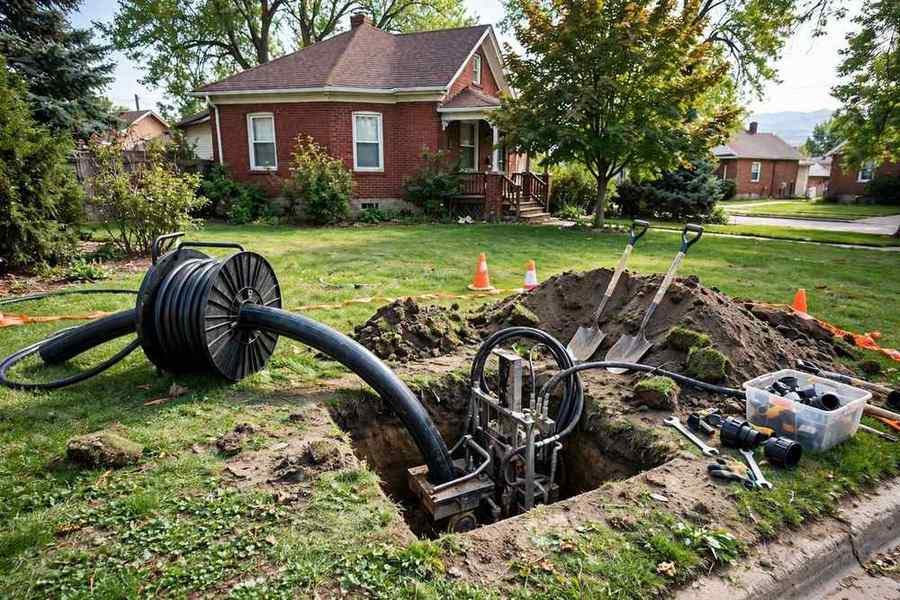
Sewer line repair is the highest-ticket residential plumbing job in Denver, and published cost ranges conflict sharply. This guide gives the published ranges with their sources, explains what drives the cost, and explains why a camera inspection comes before any quote you can rely on. None of these figures are 5280 Denver Plumbing's prices.
What published guides say
For a full sewer line replacement, Drain Brain publishes $4,000-$13,000 in one article and $5,000-$15,000 in another. Angi Denver publishes $2,010-$6,348 with an average of $3,068, which conflicts sharply and likely reflects a different scope. Go Direct publishes $9,600-$17,750 from recent jobs, with a median of $12,400. TradesProHub publishes $4,600-$17,250 for traditional replacement, $6,900-$13,800 for pipe bursting, and $4,600-$10,350 for cured-in-place lining. The ranges overlap but do not agree, because they cover different scopes, depths, lengths and methods.
Per linear foot, Angi Denver publishes $64-$265 for trenchless work, HomeGuide via Drainline publishes $60-$200 for bursting and $90-$250 for lining, and Drain Brain publishes $160-$300 for bursting. A sewer camera inspection is published at $150-$500 by multiple guides, with pre-purchase scopes around $150-$300 in Denver.
What drives sewer line repair cost in Denver
- Length and depth: the lateral runs from the house to the city main, including the portion under the street. Longer and deeper runs cost more to dig or bore.
- Method: traditional open-trench digging, pipe bursting, or cured-in-place lining. Trenchless methods preserve driveways, landscaping and mature trees, but they are not suitable for collapsed pipe, severe offsets, bellies, or Orangeburg in some framings. A camera inspection decides eligibility.
- Soil: Denver sits on expansive bentonite clay, which moves with the seasons and stresses buried lines. Deep lines in clay cost more to replace than shallow lines in stable ground.
- Street and right-of-way work: work in the right-of-way needs the right licences and restoration, and a Sewer Use and Drainage Permit may apply to main-line sewer work — confirm the trigger with Denver before work starts.
- Pipe material: clay, cast iron and Orangeburg laterals in older Denver homes fail differently and are replaced differently.
Repair vs. replacement
When a spot repair makes sense
A spot repair makes sense for a single crack or a short damaged section. A full replacement makes sense when the lateral is failing along its length, when roots keep returning, or when the pipe is collapsed or bellied. The camera inspection is the honest gate: it shows the material, the damage and the length, and it is the difference between a quote and a guess. See sewer camera inspection, trenchless sewer repair, sewer line repair and sewer line replacement.
Who owns the lateral
The lateral is the homeowner's, to the main
The homeowner owns the private lateral from the house to the city main, including the portion under the parkway and the street. The city is responsible only for the main public sewer. That is why a lateral replacement is the homeowner's job, and why it is worth scoping before you buy a home: a pre-purchase camera scope is standard practice in Denver homebuying because clay laterals are a hidden liability.