Tankless Water Heater Repair in Denver, CO
A tankless unit that throws an error code, runs lukewarm, or shuts off mid-shower usually has a specific cause: scale in the exchanger, a sensor fault, or a gas or venting problem. We diagnose the unit and fix what actually failed.
Service overview
Error codes, scale, and the parts that fail
Tankless water heater repair in Denver is the diagnosis and fix of an on-demand unit that has stopped heating properly, started throwing error codes, or begun shutting down under load. The most common Denver cause is scale: Denver Water reports hardness of about 89–105 mg/L (5.2–6.1 gpg), and mineral scale builds up in the heat exchanger, restricts flow, and forces the unit to work harder until it faults. Beyond scale, the usual faults are sensors, the igniter and flame rod, the fan, and the gas supply. Because a tankless unit has no stored hot water to fall back on, a fault shows up immediately as a cold or lukewarm shower, and the error code on the display is the first clue we work from.
! Common warning signs
Error codes or shutdowns
The display's error code points at the system involved: ignition, flame sensing, fan, or flow. We read the code and test the parts behind it rather than clearing it and hoping.
Lukewarm water or temperature swings
Scale in the exchanger, a failing sensor, or a gas supply that cannot keep up all show up as water that never quite reaches temperature or swings hot and cold.
No hot water at all
A failed igniter, a flame sensor that will not prove flame, or a flow sensor that does not register demand can leave the unit silent. We test each in turn.
Scope of work
What a tankless repair visit covers
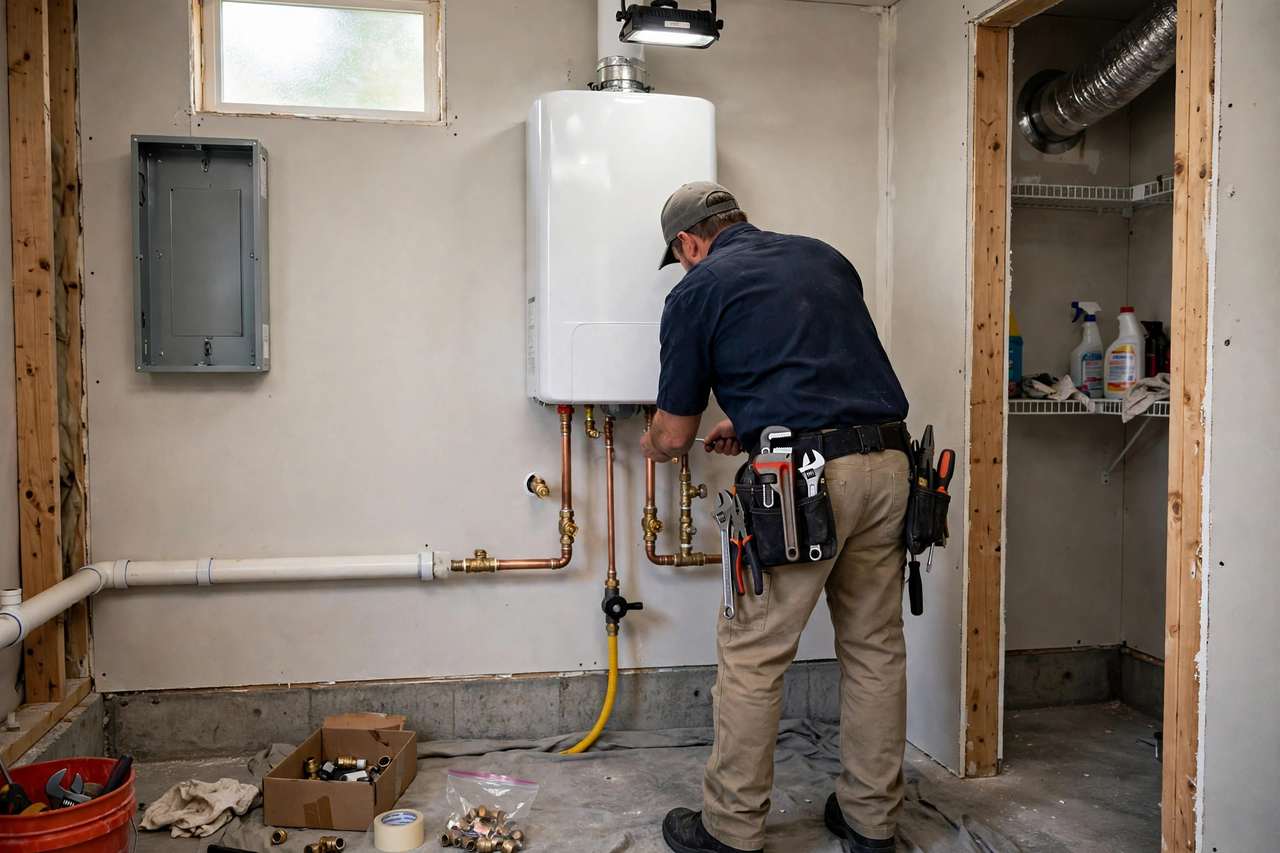
A tankless repair starts with the error code and the symptoms: we read what the unit reports, test the part it points to, and check the heat exchanger for scale before any part is replaced. Here is what the visit covers.
-
01
Error-code diagnosis
We read the unit's error code, check the manual's fault path for that model, and test the sensor, igniter, fan, or valve the code points to.
-
02
Descaling and flushing
When scale is the cause, we flush the heat exchanger through the isolation valves with a descaling solution, restoring flow and heat transfer without opening the unit up.
-
03
Sensor, igniter, and fan service
Flame sensors, flow sensors, igniters, and fans are tested and replaced when they have failed, and the gas supply and venting are checked alongside them.
-
04
Testing under load
After the fix, we run the unit at several flow rates and across the fixtures it serves, so the repair is confirmed under the conditions that exposed the fault.
Repair or replace: how the call is made
A tankless unit with a failed sensor or a scaled exchanger is usually worth repairing, and descaling alone can restore a unit that has been slowly losing performance for months. A unit with a failed heat exchanger, or one that has needed repeated major repairs, is a different conversation, and we lay out both options when the diagnosis points that way.
Call (720) 599-7253Tools and methods we use
Descaling pump and solution
Circulates descaling solution through the heat exchanger via the isolation valves, dissolving scale without dismantling the unit.
Multimeter
Tests igniters, sensors, and fan motors so we replace the part that failed rather than the parts around it.
Manometer
Checks gas pressure at the unit under full fire, which is how we tell a gas-supply problem from a unit problem.
Flow and temperature testing
Runs the unit at several flow rates to confirm it holds temperature after the repair, under the conditions that exposed the fault.
Local execution
Scale is the Denver story for tankless repair. With hardness around 89–105 mg/L (5.2–6.1 gpg), a unit that has never been descaled will lose performance steadily, and the first sign is often a shower that runs lukewarm when a second fixture opens. Homes in Capitol Hill and Park Hill with older gas lines sometimes add a second factor: a supply that was fine for a tank can struggle to feed a tankless unit at full fire, and the unit faults under load. In Highland and Cherry Creek, where tankless conversions often followed a remodel, the venting route and condensate drain are the other things we check when a unit starts throwing codes.
Why Denver tankless units fault
What to tell us when you call
Tankless unit acting up? Call to book a repair visit
What to do while you wait
A tankless fault shows up as a cold shower, and there is no stored hot water to fall back on. Call (720) 599-7253, tell us the error code if the display shows one, and we will confirm availability when you call. Do not open the unit or adjust the gas supply yourself; if you smell gas, leave the home and call your gas utility.
What to expect from your tankless water heater repair in Denver
Call and describe the fault
Call (720) 599-7253 and tell us the error code, whether the water is lukewarm or cold, and when the unit was last descaled if you know. We set a time that fits your day.
On-site diagnosis
We read the error code, test the sensor, igniter and fan it points to, and check the heat exchanger for scale before any part is replaced. Gas supply is assessed as part of the diagnosis, and we confirm at booking whether any gas-line work is within the scope we can take on.
Repair and testing under load
The failed part is replaced or the exchanger is descaled, and the unit is run at several flow rates so the repair is confirmed under the conditions that exposed the fault.
What shapes the cost of tankless repair in Denver
We do not publish prices for tankless water heater repair: a descale, a sensor swap and a fan fault are three different jobs. We talk through what the repair involves before any work starts, so you can decide with the facts in front of you.
The fault itself
A descaling flush and a failed sensor are different jobs, and a heat exchanger fault is different again. The diagnosis sets the scope.
Unit age and service history
A unit that has been descaled regularly is usually a straightforward repair. One that has never been flushed may need more work to restore flow and heat transfer.
Access and parts
A wall-mounted unit in an open utility room is simpler to work on than one packed into a tight closet, and specialized components shape the scope of the job.
Before any work starts
Frequently asked questions
Why does my tankless unit keep throwing an error code?
The code points at the system involved: ignition, flame sensing, fan, or flow. Scale in the heat exchanger is the most common Denver cause, but a failing sensor or a gas supply that cannot keep up can throw the same codes. We test the parts behind the code rather than clearing it and hoping.
How often should a tankless unit be descaled in Denver?
Denver Water reports hardness of about 89–105 mg/L (5.2–6.1 gpg), so scale builds up steadily. How often descaling is needed depends on use and on the unit, and we can advise from the condition of the exchanger when we see it.
Why is my tankless water only lukewarm?
Scale in the exchanger, a failing temperature sensor, or a gas supply that cannot feed the unit at full fire all show up as lukewarm water, especially when a second fixture opens. Diagnosis tells them apart.
Should I repair or replace my tankless unit?
A failed sensor or a scaled exchanger is usually worth repairing. A failed heat exchanger, or a unit that has needed repeated major repairs, is a different conversation. We lay out both options when the diagnosis points that way.
More on tankless: Tankless vs tank water heaters: cost and efficiency in Denver.
Related services
Tankless Water Heater Installation
If the unit is past repair, the installation page covers sizing for Denver's cold inlet water, gas-line work, and venting.
Water Heater Repair
For a conventional tank that has stopped heating or started leaking, the tank repair page covers diagnosis and the repair-or-replace call.
Tankless trouble in Denver? Call us
Call (720) 599-7253 and tell us the error code and what the water is doing. We will confirm availability and diagnose the unit.