
Frozen pipe repair in Denver, from thaw to fix
Denver's freeze-thaw cycle is what splits pipes here, not steady cold. A line freezes in an exterior wall or crawlspace, and the split shows only at thaw, when water pressure returns. We thaw the line safely, replace the split section, and talk through prevention for the next cold snap. Call (720) 599-7253 to book.
Service overview
What frozen pipe repair in Denver involves
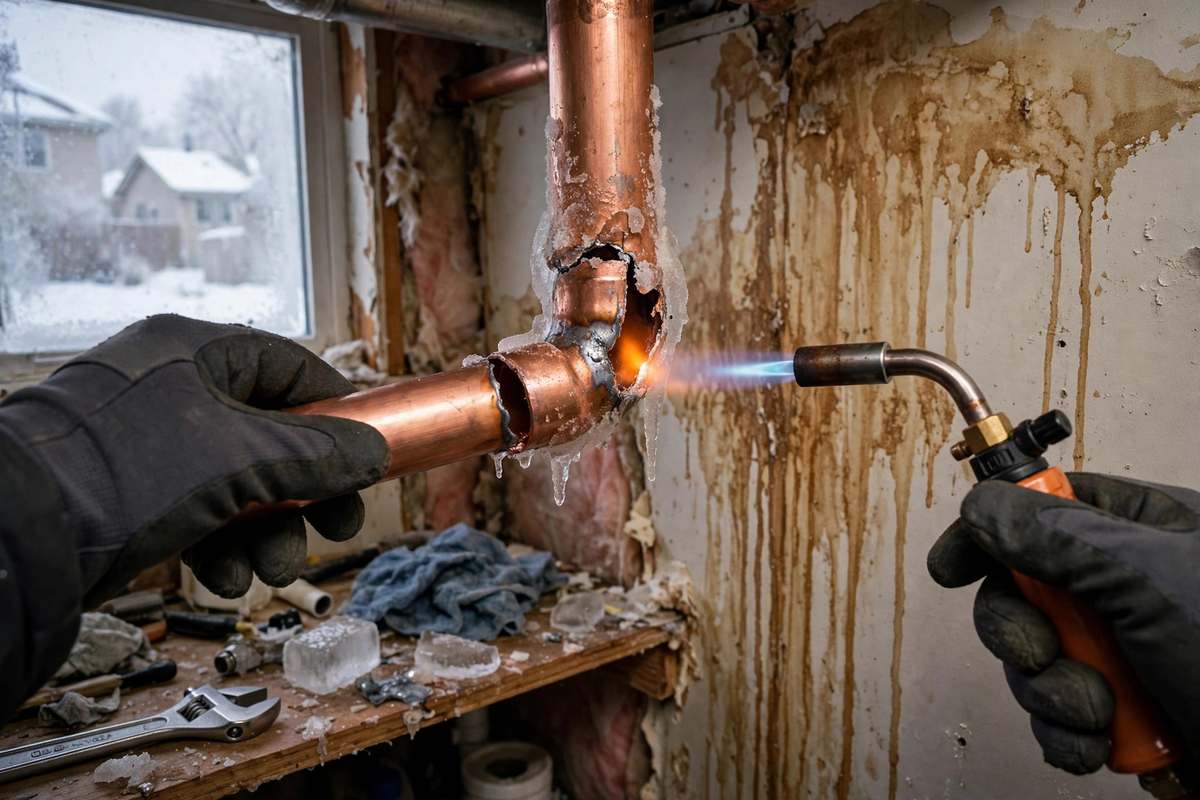
Frozen pipe repair in Denver covers three jobs in one visit: thawing the frozen section without damaging the pipe, replacing the section that split, and preventing the next freeze at the same spot. The split rarely sits where the ice plug formed; water pressure builds behind the plug and the pipe fails feet away, often in a wall cavity that shows no sign of trouble until the thaw. The vulnerable spots in Denver homes are the same every winter: exterior walls, crawlspaces, garages, hose bibs, and rim joists.
! Signs a pipe has frozen
No water, or a trickle, from a fixture in cold weather
A fixture that stops running during a cold snap, while others still work, usually means the line to that fixture has frozen. Do not force the faucet; the ice is blocking the line, and pressure is building behind it.
A bulge, frost, or crack on an exposed pipe
Frost on an exposed pipe, or a visible bulge where the pipe has swollen, means the water inside has frozen and expanded. That section is the one most likely to split at thaw.
Water appearing in a wall or ceiling as temperatures rise
Water showing up as the temperature rises is the classic Denver pattern: the pipe froze without splitting, then split when the ice thawed and pressure returned. Shut off the main if you can reach it safely, then call.
Scope of work
What our frozen pipe repair includes
Every frozen pipe visit follows the same order: stop the water if the line has split, thaw safely, repair the failure, and prevent the next freeze. Here is what that covers.
-
01
Safe thawing
We thaw the frozen section with controlled heat, working from the fixture back toward the feed so the ice melts in the direction the water can escape. We do not use open flame on a frozen line, and we do not thaw a line that has already split until the water is off.
-
02
Split section replacement
We cut out the split section and rebuild it in copper or PEX to match the run. Where the pipe is too far gone to patch, we replace the run and say so before we start.
-
03
Pressure test and verification
After the repair, we restore water and pressure-test the line. Every joint gets checked before we call the job done, and we check the rest of the run for the next weak spot.
-
04
Prevention for the next cold snap
We talk through insulation, hose bib shutoff, and where the main shutoff sits, so the same line does not freeze again. Prevention is part of the visit, not a separate sales call.
Why Denver homeowners call us for frozen pipes
Denver's winters are freeze-thaw winters, not deep-freeze winters. Temperatures swing from mild days to single-digit nights, and the median winter here has more than a hundred days when the temperature crosses freezing in both directions. That cycling is what splits pipes: the line freezes, thaws, freezes again, and each cycle works the joints a little looser. The repair is only half the job; finding why that line froze, and fixing the exposure, is the other half.
Book a frozen pipe visitTools and methods we use for frozen pipes
Controlled thawing equipment
Applies heat to a frozen section in a controlled way, working from the fixture back toward the feed. The goal is to melt the ice where the water can escape, not to shock the pipe.
Pipe camera inspection
Lets us see inside the line after thawing to confirm the split location and check for further damage before we cut anything.
Leak detection equipment
Acoustic listening narrows a split behind a wall down before anything is opened, so the opening lands on the failure rather than on a guess.
Pipe insulation and materials
Used to protect the repaired section and the exposed runs around it. Insulation, heat tape where appropriate, and proper shutoff for hose bibs are the prevention that keeps the repair from repeating.
Local execution
Denver's freeze season is long: the first freeze usually arrives in early October and the last in early May, and January nights average around 18 degrees. Pipes begin to freeze below about 20 degrees, especially exposed and uninsulated lines, and outdoor hose bibs freeze quickly at that temperature. The homes most at risk are the ones with the oldest exposure: in Capitol Hill, Baker, and Five Points, the pre-1950 stock has supply lines in exterior walls and rim joists that were never insulated to a modern standard. In Highland and Berkeley, the bungalows have crawlspaces where the lines run unprotected. In Park Hill and Washington Park, the hose bibs sit on exterior walls behind mature landscaping that blocks the sun. In the 1950s southwest, Harvey Park and Mar Lee, the ranches have lines in garages and crawlspaces that drop below freezing on the coldest nights. The main shutoff in most Denver homes sits in the basement, near where the service enters on the street-facing wall, and knowing where it is before the thaw is the difference between a repair and a flood.
How frozen pipe repair runs in Denver
What frozen pipe work usually looks like
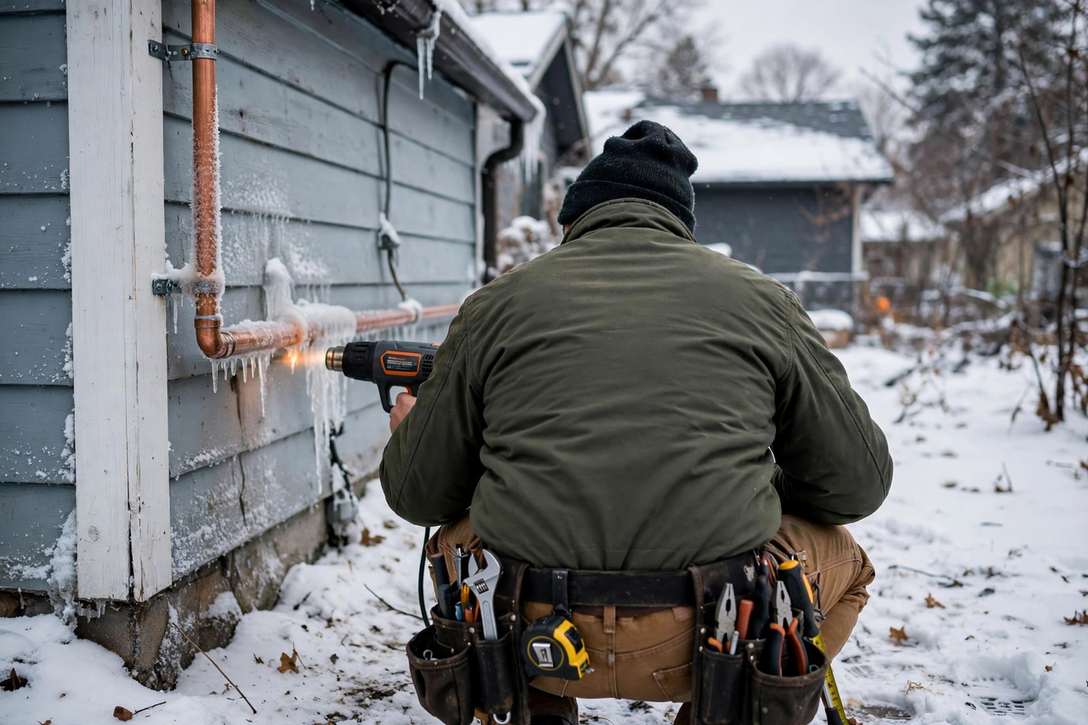
A frozen pipe is a thaw problem, not just a cold problem
Call (720) 599-7253 to book a frozen pipe visit
If a fixture has stopped running in cold weather, or water is appearing as temperatures rise, shut off the main if you can reach it safely, then call (720) 599-7253. We will confirm availability when you call. Do not use open flame on a frozen line, and do not leave a split line running while you wait for a visit; the main shutoff is the step that limits the damage.
How our frozen pipe repair works
Call and quick questions
You call (720) 599-7253. We ask which fixtures have stopped, whether water is appearing anywhere, and whether you have shut off the main. If you have not, we walk you to the shutoff first.
Thaw and locate
We thaw the frozen section with controlled heat and locate the split with listening equipment or a camera. The repair is quoted before we cut anything, and if the run is failing in several places, we lay out the repair-versus-replacement choice.
Repair, test, and prevent
We replace the split section, pressure-test the line, and talk through insulation and hose bib shutoff for the next cold snap, so the same line does not freeze again.
What affects the cost of frozen pipe repair in Denver
We quote the repair before we start. The factors below are what move the number, and the prevention work is quoted alongside the repair, not after it.
Access to the frozen section
An exposed line in a crawlspace is the simplest repair. The same split behind finished drywall, under a slab, or inside an exterior wall takes longer to reach and to make right.
How much of the run failed
A single split is one kind of job. A run that froze in several places, or a line that has split before, is a replacement decision, and it is quoted as a run rather than as several patches.
Prevention work included
Insulating the repaired section and the exposed runs around it, and fitting proper shutoff for hose bibs, adds to the visit and prevents the next freeze. We quote it with the repair, so you can decide with the full picture.
How to reach us
Frozen pipe questions Denver homeowners ask
How much does frozen pipe repair cost in Denver?
The cost depends on access, how much of the run failed, and what prevention work is included. An exposed line is the simplest repair; the same split behind finished drywall takes longer. We quote the repair before we start.
What should I do first if a pipe freezes in Denver?
Shut off the main valve if you can reach it safely, then call a plumber at (720) 599-7253. Do not use open flame on a frozen line. In most Denver homes the main shutoff is in the basement, near where the service enters on the street-facing wall.
Why do Denver pipes burst at the thaw?
A frozen pipe in Denver usually fails on the thaw, not the freeze: mild days and single-digit nights in turn let ice form, and when it melts the returning pressure opens the split, often feet from where the ice plug sat. We thaw the line and then look for the split the thaw reveals.
How do I prevent frozen pipes in Denver?
Insulate exposed pipes in crawlspaces, garages, and exterior walls, disconnect garden hoses and shut off outdoor faucets before the first freeze in early October, and know where the main shutoff is. Pipes begin to freeze below about 20 degrees, especially uninsulated lines, so the work is done before the cold arrives, not during it.
Further reading: How to prevent frozen pipes in Denver this winter.
Related services
Emergency Plumbing
A frozen line that has split and is running water is urgent: we shut off the water, isolate the failure, and repair the line before it floods the house.
Pipe Repair
A split from freezing is a pipe repair, and the same diagnosis applies: find the failure, replace the section in matched materials, and pressure-test before the wall closes.
Leak Detection
A split hidden behind a wall can run for days before it shows. We find the failure with acoustic listening and thermal imaging before anything is opened.
Pipe frozen or split? Call (720) 599-7253
Call (720) 599-7253 to book a frozen pipe visit. Shut off the main first if you can reach it safely, and we will confirm availability when you call.