
Sewer line replacement in Denver, from camera to backfill
When roots, shifting soil, or a collapsed clay pipe keep backing up your drains, replacement is the permanent fix. We camera the line first, show you exactly what is failing, then install new pipe built for Denver's freeze-thaw ground. Call (720) 599-7253 to book a camera inspection.
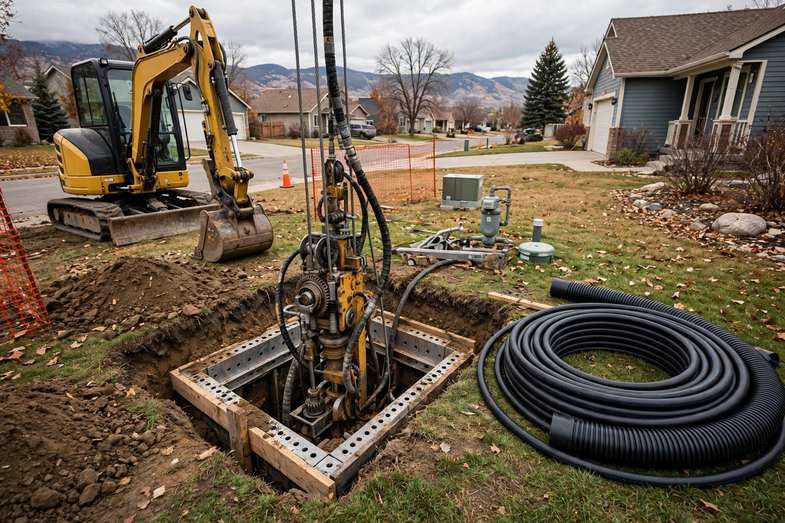
Service overview
What sewer line replacement in Denver actually involves
Sewer line replacement in Denver is the full removal and reinstallation of the pipe running from your home to the city main, and it is the right call when the line is failing in several places at once. In Denver, the homeowner owns that lateral, including the section under the street. Replacement is also the moment to correct the slope, the bedding, and the connection at the main, so the new line drains the way it should for decades.
! Common warning signs
Repeated drain backups in multiple fixtures
When the toilet, shower, and laundry all back up at once, the blockage is in the main line, not a branch. Ignoring it leads to sewage on the floor and a repair that grows with every backup.
Soggy patches or sewage smell in the yard
Wet spots along the sewer path and a persistent smell mean the pipe is leaking underground. That water saturates soil, undermines walkways, and can contaminate the ground around the line.
Slow drains throughout the whole house
Every drain running slow points to a partially blocked or sagging main line. It usually gets worse over months, and by the time it fully blocks, the line has often failed in more than one place.
Scope of work
What is included in a sewer line replacement
Every replacement we quote covers the full job from diagnosis to cleanup, so there is no second invoice for the parts that matter. Here is what you get.
-
01
Camera inspection and locating
We run a pipe camera through the cleanout, mark the break depth, and locate the city main tie-in. You watch the monitor with us. This is the step that decides whether replacement is needed at all.
-
02
Permit and inspection
We pull the Sewer Use and Drainage Permit and schedule the inspection before backfill. The permit is part of the quote, and the inspection sign-off is part of the job.
-
03
New pipe, fittings, and bedding
Your quote covers new PVC or ABS pipe, fittings, gravel bedding, and compaction. We set the slope to code and bed the pipe so it does not settle into a belly again.
-
04
Surface restoration and cleanup
We backfill in compacted lifts, restore the surface, and rake the yard. Spoil goes on tarps, walkways get protection, and we haul off the debris.
Why homeowners choose full replacement
A repaired pipe fails again. A replaced pipe gives you decades of service, a clean camera record, and a home that drains the way it should. When the camera shows failures at several joints, or the line is clay that has reached the end of its life, replacing the run costs less over time than repairing it one section at a time.
Book a replacement visitEquipment and methods we use
Pipe camera inspection
Pushes a camera through the line to record the exact location of cracks, roots, and bellies. You watch the monitor with us, and we save the footage for the record.
Hydro jetting machine
Blasts grease, scale, and root mass out of the line at high pressure. We use it to clear a blockage before camera work and to confirm whether the pipe is still sound.
Drain snake and auger
Cuts through soft blockages and root clusters in branch lines. A snake handles the smaller jobs so we do not run heavy equipment when a simple clear will do.
Leak detection equipment
Finds hidden leaks in supply and drain lines without demolition. It helps us confirm whether a wet yard is a sewer leak or a water line problem before we dig.
Local execution
Denver's freeze-thaw cycle is hard on buried pipe. Soil expands and contracts through the winter, which shifts joints and opens cracks that roots find. In the pre-1950 neighborhoods, Capitol Hill, Baker, Five Points, and Globeville, the laterals are clay and cast iron laid a century ago, and they are failing together. In Park Hill, laterals run longer under deep front yards, so a replacement is a longer trench or bore with more root exposure. In the mid-century southwest, Harvey Park and Mar Lee, the clay laterals laid in the 1950s are reaching end of life at the same time. And in the far northeast, Green Valley Ranch and Montbello, the stock is newer, so replacement is usually a single failed section rather than a whole run. Wherever the home sits, the lateral to the city main is the homeowner's, and main-line work requires a Sewer Use and Drainage Permit before it begins.
How sewer line replacement runs in Denver
What replacement usually looks like
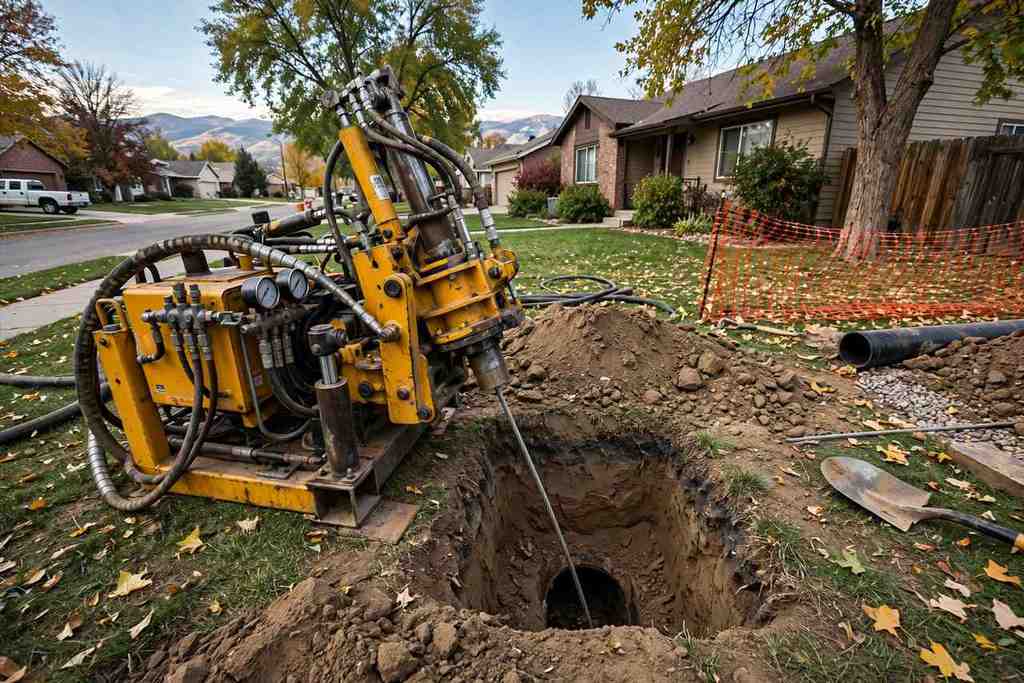
A line that keeps failing is a replacement decision, not a cleaning
Call (720) 599-7253 to book a camera inspection
If the camera shows failures at several joints, or the same line has been cleared three times in a year, the question is no longer whether to clear it again. It is whether to replace the run. Call (720) 599-7253 to book a camera inspection, and we will confirm availability when you call. We show you the footage, lay out the open and trenchless options, and quote the replacement before any digging starts.
How our replacement process works
Camera inspection
We run a pipe camera through the cleanout to see the whole line. You watch the monitor with us. We mark the break depth, note any root intrusion, and locate the city main tie-in.
Quote and permit
You get a written quote covering labor, pipe, fittings, gravel, and the permit. We pull the Sewer Use and Drainage Permit and schedule the inspection before backfill.
Excavation or trenchless pull
If we can go trenchless, we dig two access pits and pull new pipe through the old run. If the line is too damaged or the depth is wrong, we open a trench. Either way, the slope is set to code and the pipe is bedded in gravel.
What affects the cost of sewer line replacement in Denver
Replacement is the highest-ticket residential sewer job, and the quote reflects the ground, not the guess. We quote before we dig. These are the factors that move the number.
Line length and depth
Depth and length decide the job: a short, shallow run is far smaller than a long, deep one, which needs shoring, more excavation time, and more backfill and compaction.
Trenchless versus open excavation
Trenchless costs more in equipment and labor but saves on surface restoration. If the line runs under a driveway, patio, or mature landscaping, that saving is often the deciding factor.
Surface restoration and access
Cutting and replacing concrete, restoring sod, or working around tight alley access adds cost. A line under a lawn is straightforward. A line under a driveway is not.
How to reach us
Sewer line replacement questions
How much does sewer line replacement cost in Denver?
The cost depends on the length and depth of the line, whether the work is trenchless or open excavation, and what sits above the line. Published guide ranges for this work conflict sharply, so we quote your line specifically, after a camera inspection, rather than quoting a range.
How long does sewer line replacement take in Denver?
Most jobs run one to two working days from first dig to backfill. Trenchless pulls often finish in a single day because there is far less excavation. Depth, length, and access are what stretch a job past that.
What is trenchless sewer replacement in Denver?
Trenchless replacement pulls new pipe through the old line using two small access pits instead of a continuous trench. A camera inspection decides whether the line is a candidate: collapsed pipe, severe offsets, and bellies are not.
Do I need a permit for sewer replacement in Denver?
Yes. Denver requires a permit for sewer line replacement, including a Sewer Use and Drainage Permit before main-line work, and the work must pass inspection before backfill. We pull the permit and schedule the inspection.
Also worth reading: Sewer line repair cost in Denver: what homeowners should expect.
Related services
Emergency Plumbing
When a sewer line collapses and sewage backs into your basement, the job becomes urgent. We stop the backup, isolate the line, and schedule the replacement.
Drain Cleaning
Before we recommend replacement, drain cleaning with hydro jetting tells us whether the line still has life. If jetting clears the blockage and the camera looks sound, replacement can wait.
Trenchless Sewer Repair
Trenchless repair is the middle path between a spot fix and a full replacement. Pipe bursting and lining preserve driveways and mature trees when the camera says the line qualifies.
Sewer line failing? Call (720) 599-7253
A full lateral replacement starts with a camera, not a shovel: call (720) 599-7253 to book the inspection, and we will show you the footage and quote the replacement before any digging starts.