
5280 Denver Plumbing 5280 Denver Plumbing
Gateway Plumbing

Plumber in Gateway, Denver, CO

On the Tower Road side of the far northeast, Gateway is the transit-facing half of the Gateway / Green Valley Ranch statistical neighborhood — two light-rail stops, the High Line Canal, and the airport edge close by. The houses are 1990s-and-later, on copper and PEX with PVC drains, and the work runs first-cycle: first heaters, first fixtures, first supply-line repairs, with the Gaylord Rockies resort and the Panasonic campus beside the residential streets rather than in them. Your Plumber in Gateway, Denver, CO works that edge — young subdivisions, not 1950s repipes. Call (720) 599-7253 to book.

Denver
Based in Athmar Park
2022
Business started, per BBB
Call to book
(720) 599-7253 — we confirm availability when you call

About this area

Plumbing in Gateway for the far northeast transit edge

Why we work in Gateway

Gateway is the western, transit-facing side of one statistical neighborhood — Gateway / Green Valley Ranch — running east of Tower Road between 38th and 56th Avenue. Two light-rail stops serve the area, and the Gaylord Rockies resort and Panasonic campus sit nearby, close to Denver International Airport.

Young stock, same as Green Valley Ranch — set on a transit and commercial edge beside the airport.

The newest large stock in the city sits here: mostly built since the 1990s, median construction year 2007 across the statistical neighborhood, on copper and PEX supply with PVC drains. Basements run mixed — basement or slab — by subdivision, so the foundation type is confirmed at the address rather than assumed for the neighborhood.

What sets Gateway apart from Green Valley Ranch’s residential subdivisions is the setting. Transit stops, a resort and a campus sit beside the residential streets, so the diagnostic question is which side of the edge an address sits on. The home-side work is first-cycle — a first water heater, a first fixture, a first supply-line repair — and the commercial edge is a locator, not a residential load.

Services available

Plumbing services Gateway homeowners call us for

Know where the main shutoff is before winter — on the transit edge it is usually in the basement or utility area near the street-facing wall. That is the detail that decides how fast a first-cycle failure gets stopped.

Water Heater Installation

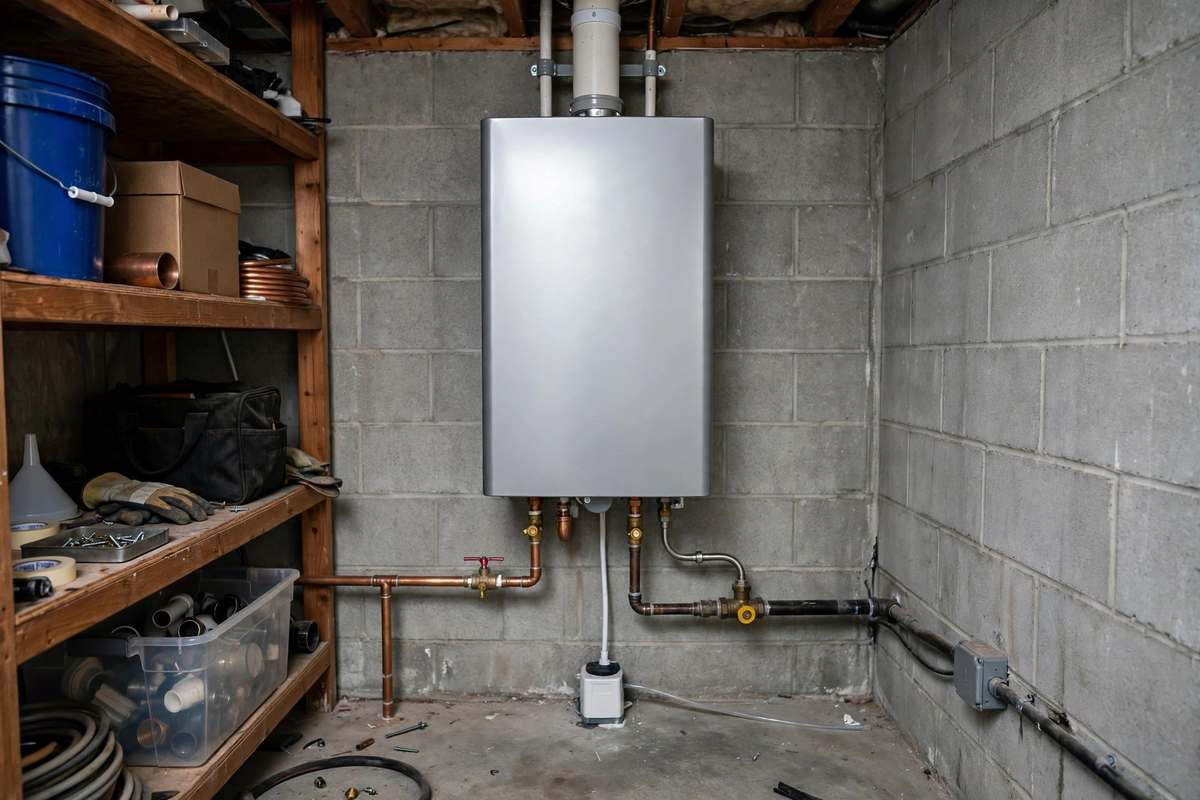
A replacement water heater is sized to the home, with permit and inspection handled as part of the job. The job itself is first-cycle work on young copper and PEX — a first heater, a first fixture, a first supply-line repair.

Learn more →

Leak Detection

A hidden leak is narrowed with meter tests, listening and pressure testing before anything is opened — the spot is found first, the wall is opened second. Most of Gateway was built since the 1990s on the Tower Road side, and the leak is usually a first-cycle fitting failure on young copper and PEX, not a system at end of life.

Learn more →

Drain Cleaning

Slow or blocked drains get cleared and then checked, so the same drain does not block again the following week. The transit stops, resort and campus beside the residential streets are locators, not a residential load — the drain work stays domestic.

Learn more →

Faucet Installation

A new kitchen or bathroom faucet is fitted with new supply lines and shut-offs where the old ones have seized. The commercial edge beside the streets does not change the job — it stays a first-cycle fixture fitting.

Learn more →

Toilet Repair

A Gateway toilet that runs, flushes weakly, or rocks is diagnosed before parts are changed — flapper, fill valve, wax ring, and flange, in that order. The stock is 1990s-and-later, so the fault is a first-cycle failure, not age.

Learn more →

Sewer Camera Inspection

Before any clearing or repair is quoted, a camera shows the line as it is — roots, offsets, bellies, or a break — and that picture is what the scope is built from. On 1990s-and-later PVC, the camera is usually looking for a belly or an offset, not a root-choked clay joint.

Learn more →

How we work locally

How we run Plumbing jobs in Gateway

Challenge: Challenge: First-cycle failures, not age

The failures here are first-cycle — a first water heater, a first fixture, a first supply-line repair on 1990s-and-later stock along Tower Road — and treating a young home like a 1950s repipe quotes the wrong job. Gateway has no Victorian or galvanized cohort to repipe.

Solution: Gateway's era and subdivision are verified at the address first, so a first-cycle repair is quoted as a first-cycle repair — the Tower Road and light-rail side decides the foundation type and the build era together.

Challenge: Challenge: Residential streets on a commercial edge

Transit stops, the Gaylord Rockies resort and the Panasonic campus sit beside Gateway’s residential streets. On an edge block, a pressure or water-quality complaint needs a mains-side check before a house-side repair is quoted.

Solution: We check the mains side of the complaint first. If the problem is in the house, we say so; if it is upstream, a house-side repair will not fix it and we will not quote one.

Neighborhoods we serve

GatewayGreen Valley RanchMontbelloCentral Park

Service area

Gateway

Latitude: 39.8561

Get Directions

Local questions

What plumbing problems are most common in Gateway?

No galvanized or clay cohort exists here to repipe. The young stock’s failures are first-cycle: a first water-heater replacement, first fixture replacements, and first supply-line repairs on copper and PEX systems built since the 1990s.

My Gateway home is from the 2000s. Is it too new to need a plumber?

No — a 2000s Gateway home is usually on its first cycle of water heater, fixtures and supply lines, so the work is first replacements and first repairs rather than an age-related repipe. A water heater is sized before it fails, not after.

Does my Gateway home have a basement?

It depends on the subdivision. Basements run mixed — basement or slab — on the Gateway side of the far northeast, where the subdivisions along Tower Road were built in different waves, so the foundation type is confirmed at the address before basement work is quoted.

How do I book a visit in Gateway?

first-cycle failures on the Tower Road and light-rail side keeps bringing it up here. Say what the house is doing and how old it is, and we will confirm availability and talk through the scope — on mostly built since the 1990s, on the Tower Road side of the far-northeast statistical neighbourhood stock the first question is usually the build era, because it decides the diagnosis. The booking starts with a call to (720) 599-7253.

About 5280 Denver Plumbing

Denver-based, working across Gateway

5280 Denver Plumbing Solutions LLC started on July 22, 2022, per the BBB, which rates it A+ (not BBB accredited) and lists no complaints in the last three years. Gateway is one of the neighbourhoods served from our Athmar Park shop at 567 S Eliot St, Denver, CO 80219 — the drive takes us out to the Tower Road side and its 1990s-and-later subdivisions.

BBB A+ Rating
Not BBB Accredited
Denver-Based 567 S Eliot St, Athmar Park
When To Call

Signs you need a plumber in Gateway

The signs below are the ones that usually mean it is time to call — catching them early is what keeps a small job small. In Gateway the quiet problems are the expensive ones: first water heaters and fixtures failing for the first time in 1990s-and-later subdivisions beside the Panasonic campus.

1. A water heater failing on a 2000s home

A first water-heater failure on the youngest large stock in the city is a first-cycle replacement in a Gateway subdivision. The replacement is sized to the home, with permit and inspection handled as part of the job, and the tank’s spot — basement or slab — is set by the subdivision, which sets how the job is staged.

2. A fixture that will not stop dripping

The fixture is repaired or replaced without disturbing the rest of the system. Its shut-offs come from the same 1990s-or-later build, so a seized valve is the exception rather than the pattern, and a first cartridge or seal failure on a newer fixture in a Gateway subdivision is a repair, not a repipe.

3. Water pooling near the base of a water heater

A puddle under the tank in a Gateway subdivision home usually means the tank itself has failed, not just a fitting. Once the steel is compromised, repair is not an option, so the unit is replaced before it floods the floor — sized to the home, with the permit and inspection handled as part of the job. The check comes before any fixture is touched.

4. Slow drains in more than one fixture

Multiple slow drains usually mean the main line is partially blocked, and a camera shows whether the cause is in the house line or further out. Which subdivision the house sits in decides how the main line was laid. One slow drain in a Gateway subdivision home is a local clog, and the check comes before any fixture is touched.

Local Problem Patterns

Common Plumbing problems in Gateway

Gateway’s plumbing problems come from first-cycle failures on the Tower Road and light-rail side: first water heaters and fixtures in 1990s-and-later subdivisions beside the Panasonic campus. Knowing which problem you have — and which system it belongs to — saves time and money, because the fix for one is not the fix for the other.

First water-heater replacements

Why it happens here

A tank that has served its first life shows up as no hot water, a leak at the base, or a pilot that will not stay lit. The 2000s housing stock is reaching its first water-heater replacements on the Gateway side of the far northeast, where the subdivisions along Tower Road were built through the 1990s and 2000s and the median home dates to 2007 — and the check comes before any fixture is touched.

Our approach

Diagnosis comes before any talk of repair or replacement in a Gateway subdivision. A replacement is sized to the home, with permit and inspection handled as part of the job, and whether the tank sits in a basement or on a slab — the subdivision decides that — changes how the replacement is staged.

First fixture replacements

Why it happens here

A dripping faucet or a running toilet is a first-cycle repair, not a sign the house needs repiping — the supply lines behind it are copper or PEX from the same 1990s-or-later build. Faucets, toilets and showers on the newer stock in the Gateway subdivisions are on their first cycle of cartridge, seal and flapper failures.

Our approach

The fixture is repaired or replaced in a Gateway subdivision, and the supply lines and shut-offs are checked at the same time — the ones from a 1990s-or-later build usually still turn, and a seized valve is treated as part of the same first-cycle repair, not a separate job.

Supply-line repairs on copper and PEX

Why it happens here

Copper and PEX supply lines fail differently from galvanized in the Gateway subdivisions: a pinhole in copper, a fitting failure on PEX, or a freeze split in an exposed run. Each one is a spot repair, not a whole-house job — and the subdivision’s build era decides which of the three is most likely at the address.

Our approach

The failure is located first in Gateway — a pressure test and a look at the run — then the section that actually failed is replaced, rather than a whole-house job quoted on a 1990s-and-later subdivision. The check comes before any fixture is touched.

Mains-side checks on edge blocks

Why it happens here

Transit stops, a resort and a campus sit beside Gateway’s residential streets, so a pressure or water-quality complaint on an edge block can sit upstream of the house.

Our approach

The mains side of the complaint is checked before house-side work is quoted, so the repair matches the actual cause.

Local Pricing

How we talk about cost in Gateway

Call (720) 599-7253 to discuss your job and what affects it. It comes back to first-cycle failures on the Tower Road and light-rail side: first water heaters and fixtures in 1990s-and-later subdivisions, beside the Panasonic campus. The stock here is mostly built since the 1990s, on the Tower Road side of the far-northeast statistical neighbourhood. For Gateway, price follows scope, and scope follows the subdivision and the system — so no prices are published. That pattern follows mostly built since the 1990s.

Talking through your job: Call (720) 599-7253 about your Gateway job and expect questions first: the age of the house, where the problem shows, whether more than one fixture is affected. The scope follows from those answers, and no prices are published because first-cycle failures on the Tower Road and light-rail side: first water heaters and fixtures in 1990s-and-later subdivisions, beside the Panasonic campus.

1

Subdivision and foundation type

Basements run mixed — basement or slab — by subdivision on the Gateway side, so the foundation type at the address changes the scope of basement work. A subdivision home along Tower Road may have a full basement for a water heater and laundry, or a slab that puts both elsewhere, and the quote is built around which one it is.

2

First-cycle or end-of-life

In the Gateway subdivisions, a first water heater or fixture is a different job from an end-of-life repipe. Scope follows the era at the address: a subdivision home built since the 1990s is on first-cycle work, and the subdivision — not the city — sets which system the house actually has.

3

Permits and inspections

Water-heater replacement in Denver needs a permit and an inspection, and in a Gateway subdivision the permitted job is a first replacement on a home built since the 1990s, where the tank's location — basement or slab — is confirmed at the address before the work is quoted. We pull the permit and schedule the inspection as part of the job.

Year-Round Coverage

How seasons affect Plumbing in Gateway

In Gateway, winter freeze-thaw finds the weak points in the exposed runs of young homes, and that sets the calendar for the work below. The tips are general seasonal care for 1990s–present copper and PEX with PVC drains and the ground under them — not a service promise, and not a substitute for a diagnosis.

Spring

Spring runoff tests grading and foundation drainage on the newer subdivisions, and the transit-edge blocks see their first sump checks of the year.

Tip

Run the sump pump by hand before the first big rain to confirm it actually starts on a transit-edge lot.

Summer

Summer is first water-heater and fixture season on the young stock, with the resort and campus edge adding peak water use nearby.

Tip

A first water heater on the transit edge is a planned replacement — size it before it fails, not after.

Fall

Autumn is Gateway’s winterisation window: exposed runs on young homes are the freeze-thaw weak point, so hose bibs are shut off, the irrigation backflow preventer is winterised and exposed lines are insulated before the first freeze. That is general seasonal care, not a service promise, and no substitute for a diagnosis.

Tip

Hoses come off and hose bibs are drained before the first hard freeze, and the transit-edge irrigation is drained too.

Winter

Garages, crawlspaces and exterior walls are where the transit edge’s lines split in a winter freeze-thaw, even on newer homes.

Tip

Know where the main shutoff is before winter — on the transit edge it is usually in the basement or utility area near the street-facing wall.

Hiring Smart

What to ask before hiring a plumber in Gateway

The housing stock and the setting create specific challenges, and these are the questions we would ask if we were hiring someone for our own home here. Gateway needs a plumber set up for the Tower Road side and its 1990s-and-later subdivisions, with two light-rail stops and Denver International Airport to the northeast.

  1. 1

    “Do you pull the Denver plumbing permit for water-heater replacement?”

    Why it matters

    On mostly built since the 1990s stock, the check comes before any fixture is touched. We pull the permit and schedule the inspection ourselves. Yes, and in a Gateway subdivision the permit should match the house's foundation: a first water-heater replacement is permitted and inspected whether the tank sits in a basement or on a slab, and the inspection confirms the installation for that layout. A plumber who skips the permit leaves a problem for the next sale of the house.

  2. 2

    “How do you find a leak without opening a wall or floor first?”

    Why it matters

    Opening on a guess is how a small leak becomes a large repair. With meter tests, listening and pressure testing, a hidden leak is narrowed to a spot before anything is opened in a Gateway subdivision home — and the subdivision decides whether the search runs through a basement or a slab, which changes where a hidden leak can hide.

  3. 3

    “My Gateway house is from the 2000s — is it too new to need a plumber?”

    Why it matters

    Gateway homes built since the 1990s are mostly on their first water heater and first fixtures. The work that comes up is first-cycle replacement and repair, not repiping for age. Call (720) 599-7253 to talk through what yours needs.

  4. 4

    “What should I have ready when I call about a Gateway job?”

    Why it matters

    That tells us which system to start with — and on the Gateway side, the subdivision matters because it decides the foundation type and the build era at the same time. The age of the house if you know it, the subdivision if you know it, where the problem shows, and whether more than one fixture is affected.

Knowing the Area

Navigating Gateway on service calls

Knowing these reference points helps us find the right streets and the right era of housing on every call. The landmarks below orient our routes around Gateway: Tower Road and the two light-rail stops, with Denver International Airport to the northeast.

Landmarks

  • Tower Road

    Tower Road is the western edge of Gateway, and the route that connects the neighbourhood to the rest of far northeast Denver — the light-rail stops and the airport edge run off it.

  • Light-rail stops

    Two light-rail stops serve the area, and the station areas frame Gateway's transit-facing character.

  • Denver International Airport

    Denver International Airport sits nearby to the northeast of Gateway — a geographic locator for the far northeast neighbourhoods, not a residential market. The reference streets are Tower Road and the two light-rail stops.

Commercial Districts

  • Gaylord Rockies and Panasonic campus

    The resort and the campus sit nearby, beside the residential streets. They are locators for the area, not a residential plumbing load — the work here is first-cycle residential work.

Before we arrive

Before we arrive in Gateway, the useful details are the age of the house, where the problem shows, and whether more than one fixture is affected. With mostly built since the 1990s, on the Tower Road side of the far-northeast statistical neighbourhood on Tower Road and the two light-rail stops, with Denver International Airport to the northeast, that is what separates a local fix from main-line work, and it decides what equipment comes on the van.

Service Area

Plumbing Coverage Across Gateway & Denver

We do not list adjacent cities as service areas. We work in Gateway and the nearby Denver neighbourhoods listed below, from our shop at 567 S Eliot St in Athmar Park, Denver, CO 80219.

GatewayGreen Valley RanchMontbelloCentral Park
!

Need Plumbing in Gateway CO right now?

first-cycle failures on the Tower Road and light-rail side keeps bringing it up here. Tell us what is happening — on mostly built since the 1990s, on the Tower Road side of the far-northeast statistical neighbourhood, the first question is usually the age of the house — and we will confirm availability and talk through what happens next. If you have water where it should not be, no hot water, or a drain that will not clear in Gateway, call us on (720) 599-7253.

Call now
Call Now: (720) 599-7253