
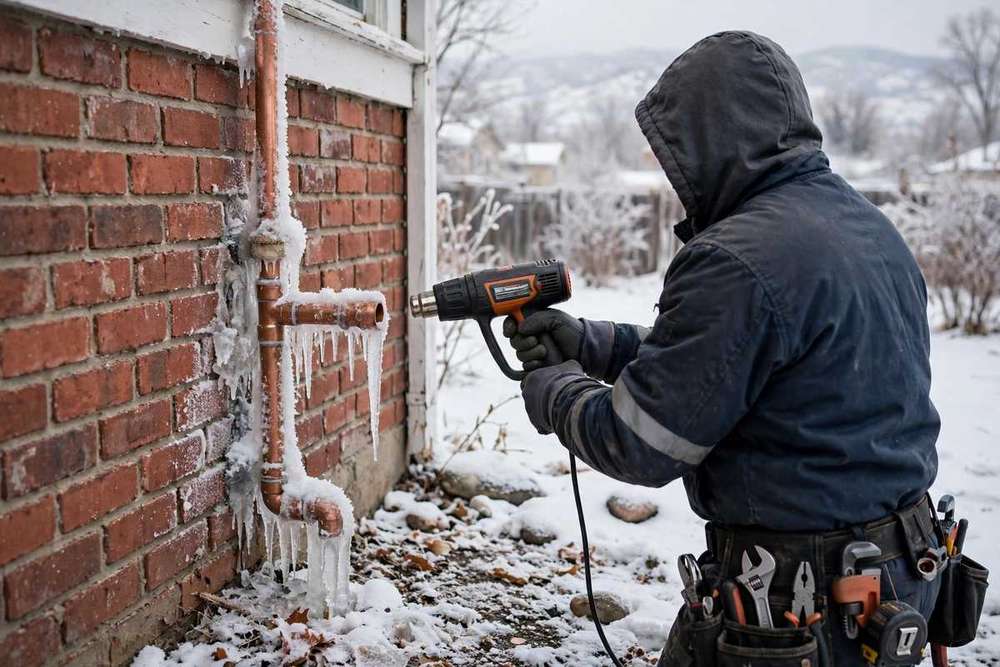
Denver's freeze season runs from early October to early May, with January lows around 18°F and about 156 nights a year at or below freezing. The damage does not come from steady cold. It comes from freeze-thaw cycling: warm days and single-digit nights that freeze a pipe, then thaw it, so the split only shows when water can flow again. Prevention is mostly about the weeks before the first freeze.
Know your main shutoff
Do this first, before anything else. In most Denver homes the main shutoff is in the basement near where the service enters, on the street-facing wall. Make sure everyone in the house knows where it is and that it turns. A burst does far less damage if the water is off in two minutes rather than twenty.
Insulate exposed pipes
Where to insulate first
Insulate pipes in crawlspaces, attics, garages, exterior walls and rim joists. Those are the places Denver pipes freeze first. Heat tape is an option for the most exposed runs. Pipes can begin to freeze below 20°F, especially exposed or uninsulated lines, and outdoor hose bibs can freeze within hours at 20°F.
Hose bibs and outdoor faucets
Disconnect garden hoses and shut off and drain outdoor faucets if they are not frost-free. A hose left connected traps water in the bib and the pipe behind it. This is the single most common preventable freeze we see.
Keep heat on and cabinets open
Keep the heat on when you are away, and open cabinet doors under sinks on exterior walls during a cold snap so warm air can reach the pipes. Denver housing rules are generally understood to require heating capable of bringing habitable rooms to at least 70°F when it is -5°F outside (a secondary-source summary, not settled law), and Colorado's warranty of habitability treats lack of functioning heat from October through April as a serious condition.
Sump pumps and backflow devices
September to early October is also the winterisation window for irrigation: sprinkler blow-out, backflow preventer winterisation, hose-bib shutoff and a sump-pump and discharge check. A sump discharge that freezes shut leaves the pump with nowhere to send water. See sump pump installation and sump pump repair.
If a pipe freezes
Warm it gently, never with a flame
If a tap gives no water in a cold snap, leave the tap open, keep the heat on, and warm the frozen section gently with a hair dryer or warm towels, working back from the tap. Never use an open flame. If the pipe has burst, shut off the main and call. See frozen pipe repair and our guide on what to do when a pipe bursts.